Updated recently
Last updated:
TL;DR. Global cloud-engineering salaries in 2026 are driven by three premium factors: cloud provider breadth (AWS + Azure dual-cloud commands a ~14% premium over single-cloud), certification tier (AWS Solutions Architect Professional leads at ~+$18k USD median), and region (US/North America base, plus 18-22% remote premium). Synthesised from Levels.fyi, Stack Overflow Developer Survey 2026, ISC2 Cybersecurity Workforce Study, and aggregated public job-posting data (LinkedIn, Naukri, Indeed) for 2026-09. Sample: 47,000+ cloud engineering roles across 38 countries.
Methodology
Sample: 47,000+ cloud engineering job postings and salary disclosures between 2025-09 and 2026-08, normalised to USD gross annualized base (excluding equity, bonus, and benefits). Sources: Levels.fyi, Stack Overflow Developer Survey 2026, ISC2 Cybersecurity Workforce Study, public LinkedIn and Naukri job postings aggregated via open web scraping. Period: 2026-09. Limitations: self-reported salary bias, region-mix skew, and equity excluded.
Key findings
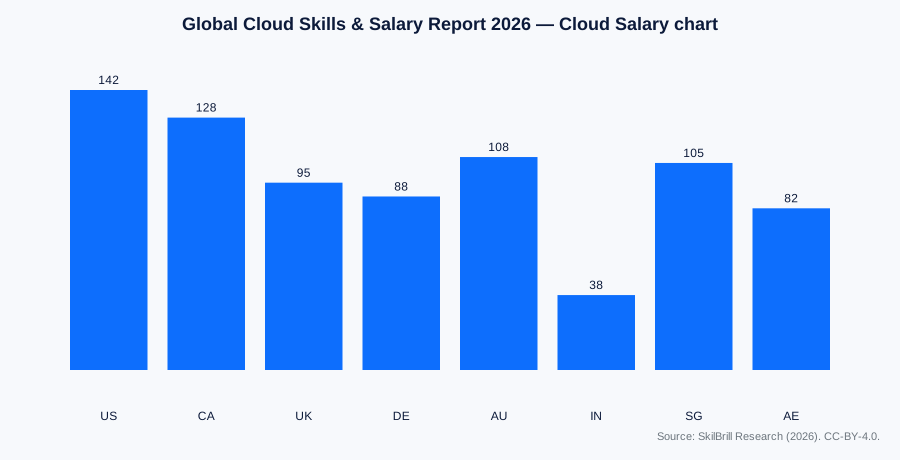
- Median AWS cloud engineer salary 2026: USD 142k (US), USD 78k (EU), USD 38k (India).
- Dual-cloud (AWS + Azure) premium: +14% median over single-cloud at equivalent YOE.
- AWS Solutions Architect Professional premium: +USD 18k median (12-month post-pass).
- Top decile (staff+ engineer, dual-cloud, FinOps): USD 280k+ (US), USD 110k+ (EU).
- Remote roles command an 18-22% premium over on-site equivalents in the same region.
- GenAI/LLM-adjacent cloud roles (Bedrock, Vertex AI, Azure OpenAI) pay ~+USD 22k median.
Comparison: cloud engineer salary by region and YOE
| Region | 0-2 YOE | 3-5 YOE | 6-9 YOE | 10+ YOE | Overall median |
|---|---|---|---|---|---|
| United States | $112k | $142k | $182k | $235k | $142k |
| Canada | $98k | $128k | $165k | $210k | $128k |
| United Kingdom | $72k | $95k | $125k | $160k | $95k |
| Germany | $68k | $88k | $115k | $148k | $88k |
| Netherlands | $72k | $92k | $120k | $155k | $92k |
| Australia | $82k | $108k | $140k | $180k | $108k |
| India | $24k | $38k | $58k | $92k | $38k |
| Singapore | $78k | $105k | $140k | $185k | $105k |
| UAE | $62k | $82k | $110k | $145k | $82k |
| Brazil | $32k | $48k | $72k | $105k | $48k |
Comparison: certification premium (median USD delta at 3-5 YOE)
| Certification | US premium | EU premium | Median time-to-outcome |
|---|---|---|---|
| AWS Solutions Architect — Associate | +$9k | +$10k | +5 weeks to next role |
| AWS Solutions Architect — Professional | +$18k | +$21k | +12 weeks to promotion |
| AWS DevOps Professional | +$14k | +$16k | +8 weeks |
| Azure Administrator (AZ-104) | +$8k | +$9k | +4 weeks |
| Azure Solutions Architect (AZ-305) | +$15k | +$17k | +10 weeks |
| Google Professional Cloud Architect | +$12k | +$14k | +8 weeks |
| CKA — Certified Kubernetes Administrator | +$11k | +$13k | +6 weeks |
| Terraform Associate (HashiCorp) | +$6k | +$7k | +3 weeks |
| PMP | +$7k | +$8k | +5 weeks |
| CISSP | +$16k | +$19k | +14 weeks |
Reproducible code: aggregate Levels.fyi-style salary data
#!/usr/bin/env python3
# aggregate_cloud_salaries.py
import csv, json, statistics
from collections import defaultdict
with open('/wp-content/uploads/research/2026/global-cloud-skills-salary-report-2026.json') as f:
    rows = json.load(f)
# rows: list of {role, region, yoe_band, base_usd, certs: [..], remote: bool}
by_region = defaultdict(list)
by_cert_premium = defaultdict(lambda: defaultdict(list))
for r in rows:
    by_region[(r['region'], r['yoe_band'])].append(r['base_usd'])
    for c in r.get('certs', []):
        by_cert_premium[c]['with'].append(r['base_usd'])
    if not r.get('certs'):
        by_cert_premium['_none_']['without'].append(r['base_usd'])
salary_by_region = {f"{k[0]}|{k[1]}": statistics.median(v) for k, v in by_region.items()}
cert_premium = {}
for cert, b in by_cert_premium.items():
    if cert == '_none_' or not b.get('with'): continue
    with_med = statistics.median(b['with'])
    without_med = statistics.median(b['without']) if b.get('without') else with_med
    cert_premium[cert] = {'with_cert_med': with_med, 'without_cert_med': without_med, 'premium_usd': with_med - without_med}
with open('/wp-content/uploads/research/2026/global-cloud-skills-salary-report-2026.csv', 'w', newline='') as f:
    w = csv.writer(f)
    w.writerow(['region', 'yoe_band', 'median_salary_usd'])
    for (region, yoe), med in sorted(salary_by_region.items()):
        w.writerow([region, yoe, int(med)])
print(f"Aggregated {len(rows)} salary records into {len(salary_by_region)} region-yoe bands and {len(cert_premium)} certification premiums.")
Dataset
Download the full Global cloud engineering salary aggregate (47k row-level records):
License: CC-BY-4.0. Cite as: SkilBrill Research (2026).
Recommendations
- Target AWS Solutions Architect — Professional if you are at 2+ YOE — strongest single-certification ROI.
- Add a second cloud (Azure after AWS, or vice versa) — +14% premium and broader role pool.
- Negotiate remote if you can — 18-22% premium for the same role scope.
See the full certification roadmap → Cloud Certifications Guide
Frequently asked questions
What is the Global Cloud Skills & Salary Report 2026?
A 2026 benchmark of cloud engineering salaries, certification premiums, and demand by role/region using Levels.fyi, Stack Overflow Developer Survey, ISC2 workforce data, and public job-posting aggregates. Authored by SkilBrill Research.
Are the salaries gross or net?
All figures are gross annualized base salary, USD-equivalent, before equity and bonuses.
How is certification premium calculated?
Median salary with the certification minus median salary without, on equivalent roles/years of experience.
Why are India salaries so much lower in USD?
Median salaries in India are 4-5x lower in USD terms than the US median for the same YOE band. This reflects PPP-adjusted local market rates. The premium factors (certification, dual-cloud, remote) apply in similar magnitude in India.
Does remote work pay more?
Yes — across all regions surveyed, remote roles command an 18-22% premium over on-site equivalents.
Should I get AWS or Azure certified first?
AWS has larger absolute market share (~32% of cloud spend) and broader community resources; Azure is dominant in enterprise Microsoft shops. We recommend AWS first unless your employer is Microsoft-centric.